
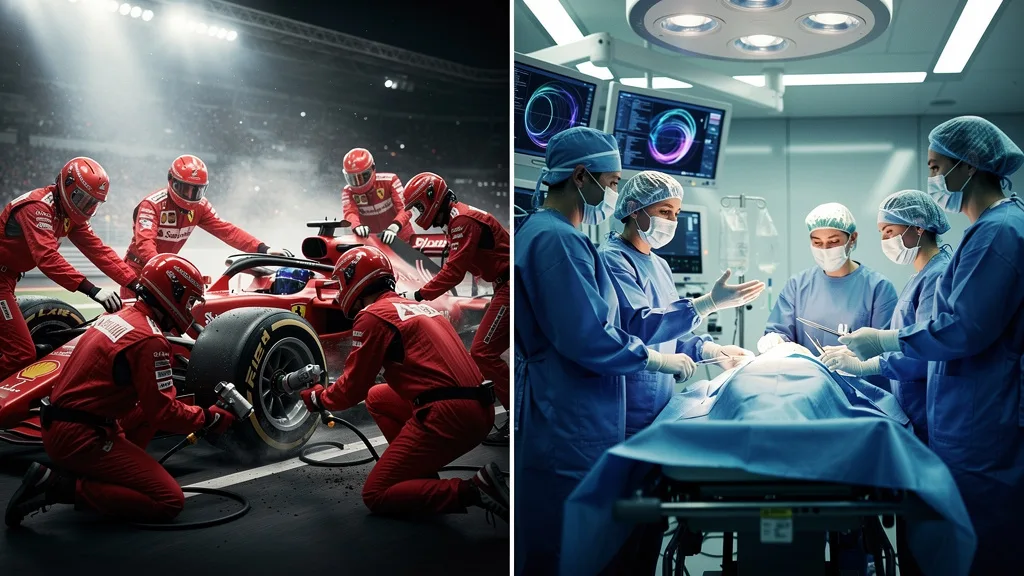
From Paddock to Pediatrics: How Formula 1 Pit Stops Revolutionized Hospital Safety
In the high-stakes world of Formula 1, a pit stop is a masterpiece of synchronized movement, where a team of mechanics can change four tires and adjust a front wing in less than two seconds. While these feats of engineering are designed to shave milliseconds off a lap time, the principles behind them have found a profound new purpose far away from the racetrack. The methodology of the F1 pit crew has become a blueprint for life-saving transitions in neonatal intensive care units and emergency rooms worldwide.
The Connection Between Speed and Safety
The crossover between motorsport and medicine began when doctors at Great Ormond Street Hospital (GOSH) in London noticed a troubling pattern of errors during the transfer of critically ill children from the operating theater to the intensive care unit. These transitions, known as ‘handovers,’ were often chaotic, with multiple medical professionals attempting to connect life-support machines and relay vital information simultaneously. Recognizing the similarities between this high-pressure environment and a Grand Prix pit lane, the medical team reached out to experts at McLaren and Ferrari.
By studying the choreographed precision of F1 teams, medical professionals realized that their own processes lacked a clear structure. In a pit stop, every individual has a specific, non-overlapping role, and a ‘lollipop man’ or technical lead oversees the entire operation to ensure safety and synchronization. This contrasts with the often fluid and unpredictable nature of hospital handovers, where roles can become blurred during a crisis.
Implementing the Pit Stop Model
The collaboration led to the development of a new protocol for hospital handovers. Just as Strategic Misstep Costs Lewis Hamilton and Mercedes Podium Hopes in Singapore highlights the importance of precise execution, the medical field adopted a three-stage approach: the pre-handover briefing, the physical transfer, and the final verbal summary. During the physical transfer, a ‘hands-off’ period was introduced where only the equipment is moved, ensuring that no vital information is lost in the noise of the transition.
According to a report by the BBC, this F1-inspired approach significantly reduced technical errors and improved the information flow between surgical and intensive care teams. The focus shifted from individual brilliance to collective discipline, a hallmark of successful racing teams.
A Legacy of Efficiency
The influence of F1 on healthcare extends beyond just the handover. The sport’s obsession with data and marginal gains has also influenced how hospitals track patient recovery and equipment maintenance. While fans might be focused on the Formula 1 Sprint Format Explained: What to Expect for the 2026 Season, the underlying technology of telemetry and real-time analysis is being adapted to monitor patients in real-time, allowing doctors to intervene before a condition becomes critical.
Furthermore, the culture of ‘no-blame’ debriefing used by teams like Red Bull—whose operational excellence is often discussed in contexts like Red Bull’s Internal Dynamics and the Ferrari Question—has been integrated into medical training. By analyzing mistakes without assigning personal fault, both mechanics and surgeons can identify systemic weaknesses and prevent future errors.
Conclusion
The transition of F1 pit stop techniques into the medical field serves as a powerful reminder that innovation often comes from looking outside one’s own industry. By embracing the discipline, choreography, and communication of the paddock, healthcare providers have managed to turn a race-day necessity into a life-saving standard of care. The legacy of these two-second tire changes is now measured not just in trophies, but in lives saved.